 HAPPY
HAPPYAlexandria in 2 Days: Itinerary, Sights, Seafood and Where to Stay
Updated October 2026 · The HAPPYDAYS team
Alexandria is Egypt’s Mediterranean city: a long seafront Corniche, a fortress built where the ancient Lighthouse once stood, a modern library that revives the most famous library of the ancient world, and Roman tombs hidden underground. Two days are enough to see the highlights without rushing. This guide gives you a ready-made 2-day plan, how to get there from Cairo, when to go and where to stay.
In short:
- Time: 2 full days cover the main sights comfortably.
- From Cairo: train about 2–3 hours on the faster services, bus about 3–3.5 hours.
- Must-sees: Qaitbay Citadel, the Bibliotheca Alexandrina, the Catacombs of Kom el Shoqafa, Pompey’s Pillar, the Roman Amphitheatre, the Royal Jewellery Museum and Montaza gardens.
- Tickets and hours: they change, so check the official site of the Ministry of Tourism and Antiquities (egymonuments.gov.eg) and the Bibliotheca’s own website.
- Best season: spring and autumn. Summer is packed with Egyptian holidaymakers.
Getting there from Cairo
- Train: the most comfortable option. Trains leave from Ramses station in Cairo and arrive at Misr (Mahattat Masr) or Sidi Gaber station in Alexandria. The faster services take about 2–3 hours; slower trains with more stops take longer. Book ahead at weekends and in summer.
- Bus: several companies run frequent air-conditioned buses from Cairo, taking about 3–3.5 hours depending on traffic.
- By car: roughly 3 hours via the Cairo–Alexandria Desert Road, longer at holiday peaks.
Within Alexandria, taxis and ride-hailing apps are the easiest way to move between sights, since the city stretches for many kilometres along the coast.
Day 1: Ancient Alexandria and the Eastern Harbour
Catacombs of Kom el Shoqafa
Start with the most unusual site in the city. These Roman-era tombs were discovered by chance in 1900, when, as the story goes, a donkey fell through a hole in the ground. Spiral stairs lead down into burial chambers whose carvings mix Egyptian, Greek and Roman styles: Egyptian gods dressed as Roman soldiers, for example. The lowest level is flooded and closed. Photography rules vary, so ask at the entrance.
Pompey’s Pillar and the Serapeum
A short ride away, a single column of red Aswan granite, about 30 metres high, rises over the ruins of the Serapeum, the great temple of the god Serapis. Despite its name, it has nothing to do with Pompey: it was erected around AD 291 in honour of the emperor Diocletian. Walk down to the underground passages beneath the temple area and look for the sphinxes nearby.
Roman Amphitheatre (Kom el Dikka)
Close to Misr station in the city centre, this small marble theatre was uncovered during building works in the 20th century and excavated by a Polish archaeological mission. Around it you will find the remains of Roman baths, villas with mosaics and lecture halls. It is a compact site: an hour is usually enough.
Qaitbay Citadel
In the afternoon head to the tip of the Eastern Harbour. The Mamluk sultan Qaitbay built this fortress in 1477–1479 on the site of the ancient Lighthouse of Alexandria (the Pharos), one of the Seven Wonders of the Ancient World, which had been ruined by earthquakes. Walk the walls, look out over the sea and stay for the late-afternoon light.
The Corniche and seafood dinner
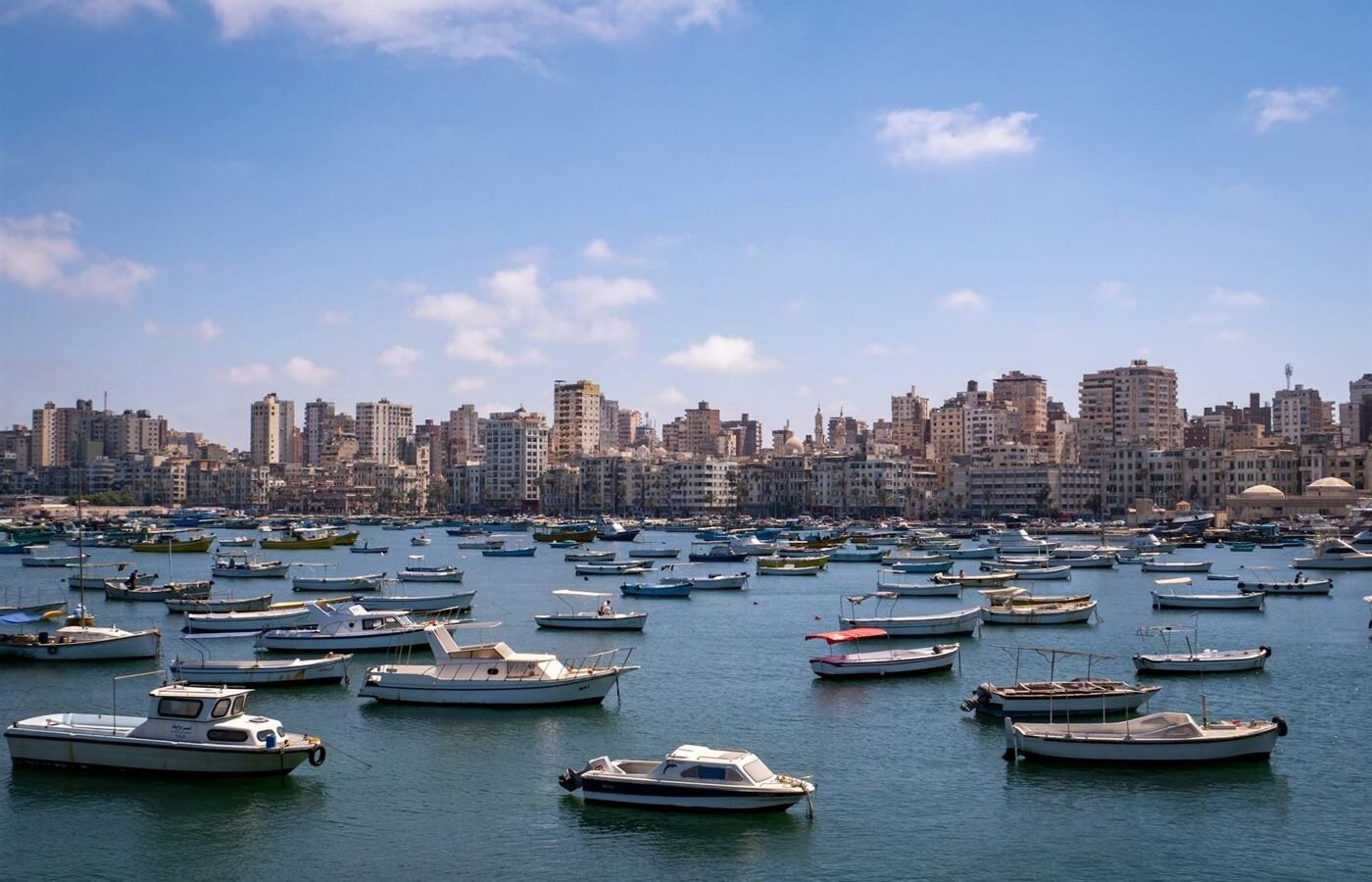
Walk along the Corniche around the Eastern Harbour as the sun goes down, with the fishing boats in the bay. Then have dinner the Alexandrian way: at many seafood restaurants you choose your fish and shellfish from the display, pay by weight and they grill or fry it for you, served with salads, rice and bread. The Anfushi area near the citadel is a classic area for fish restaurants.
Day 2: The Library, palaces and the sea
Bibliotheca Alexandrina
Opened in 2002 near the site of the ancient Library of Alexandria, this huge library is a landmark in its own right: a tilted, disc-shaped roof and a granite wall carved with letters from scripts around the world. Inside, besides the vast reading room, there are museums (including antiquities and manuscripts) and a planetarium. Some areas require separate tickets; check the official website.
Royal Jewellery Museum
In the Zizinia district, this museum occupies the elegant palace of Princess Fatma Haidar, a member of the Muhammad Ali dynasty. It displays jewellery, decorations and precious objects that belonged to Egypt’s royal family. The palace itself, with its painted ceilings and stained glass, is half the visit.
Stanley Bridge
On your way east along the Corniche, stop at Stanley Bridge, one of the city’s best-known landmarks, built over the sea next to Stanley Bay. It is a favourite spot for photos, especially in the evening when it is lit up.
Montaza Palace gardens
End your trip at the eastern edge of the city. Montaza was the summer residence of Egypt’s royal family. The palace buildings are generally not open inside, but the large gardens, palm-lined paths and small bays are a lovely place to walk and watch the sunset over the sea.
The 2-day plan at a glance
| Time | Day 1 | Day 2 |
|---|---|---|
| Morning | Catacombs of Kom el Shoqafa, then Pompey’s Pillar | Bibliotheca Alexandrina (2–3 hours) |
| Midday | Roman Amphitheatre (Kom el Dikka) and lunch downtown | Royal Jewellery Museum |
| Afternoon | Qaitbay Citadel | Corniche drive east, photo stop at Stanley Bridge |
| Evening | Corniche walk and seafood dinner | Sunset in Montaza gardens |
When to go
Spring and autumn are the best seasons: mild weather, comfortable for walking, and fewer crowds. Summer is the city’s high season, when Egyptian families come for the beaches, so hotels, trains and the Corniche are much busier and traffic is heavy. Winter is cooler, with wind and occasional rain, but sightseeing is still pleasant.
Where to stay in Alexandria
The city is long and thin, so where you stay shapes your trip:
- On the seafront (Corniche): sea views and easy evening walks. The eastern districts around Stanley and towards Montaza are calmer and more residential.
- Downtown and near the Eastern Harbour: close to Misr station, Kom el Dikka, the Bibliotheca and Qaitbay, ideal if you arrive by train and want to walk to the sights.
Here are stays in Alexandria from our partners:
Frequently asked questions
Are 2 days enough for Alexandria?
Yes, two full days cover the main sights. Add a third day if you want time for the beach or a slower pace.
Can I visit Alexandria as a day trip from Cairo?
It is possible but tiring: about 2–3 hours each way by the faster trains, so you would see only a few sights. Staying at least one night is much better.
Where can I check ticket prices and opening hours?
For the antiquities sites and the Royal Jewellery Museum, check egymonuments.gov.eg; for the Bibliotheca Alexandrina, its official website. Prices and hours change, so check close to your visit.
Is the Lighthouse of Alexandria still standing?
No. The ancient Lighthouse was destroyed by earthquakes centuries ago, and Qaitbay Citadel was built on its site in 1477–1479.
How do I get around the city?
Taxis and ride-hailing apps are the easiest option, as the sights are spread along the coast. Walking works well between downtown, the Eastern Harbour and Qaitbay.