 HAPPY
HAPPYWhite Desert & Bahariya Oasis Guide: A Night Under the Stars from Cairo
Updated October 2026 · The HAPPYDAYS team
A few hours west of Cairo, the asphalt gives way to some of Egypt’s strangest landscapes: hills dusted with black stones, a ridge that glitters with crystals, and a plain of white chalk sculpted by the wind into mushrooms, cones and animal shapes. Spending a night in the White Desert, under more stars than you have probably ever seen, is one of the most memorable trips you can make from Cairo. This guide covers the route through Bahariya Oasis, what you will see along the way, when to go, what to pack and a simple 2-day plan.
In short:
- Getting there: Bahariya Oasis (the town of Bawiti) is about 350–370 km from Cairo, roughly 4–5 hours by road. The White Desert lies further south, towards Farafra.
- How: with a licensed operator in a 4×4. Operators usually handle permits for the protected area; confirm when booking.
- Time needed: 2 days and 1 night is the classic trip; add a night if you want it slower.
- Best season: October to April. Avoid the summer heat and the spring sandstorms.
- Bring: warm layers. Desert nights are cold, especially in winter.
Where it is and how to get there
The trip starts on the desert road from west Cairo to Bahariya Oasis. Its main town, Bawiti, is the gateway to the area, and this is usually where you switch to a 4×4 with a local driver and guide. From Bawiti the road continues south towards Farafra Oasis, passing the Black Desert and Crystal Mountain, before reaching the White Desert National Park, a protected area since 2002 in the Farafra depression.
Driving the open desert yourself is not a good idea: the best spots are off-road, there is little mobile signal, and the park is protected. Go with a licensed operator who knows the tracks and the camping areas.
What you will see along the way
The Black Desert
South of Bawiti the sand turns orange-brown and is scattered with volcano-shaped hills capped with dark stones, giving the area its name. Many trips stop to climb one of the hills for the view over the plain.
Crystal Mountain
A small ridge beside the road between Bahariya and Farafra, made of quartz and calcite crystals that sparkle in the sun. It is a short stop, but a striking one. Look, photograph, and leave every crystal where it is.
Agabat valley
Near the White Desert, Wadi Agabat is a valley of tall rock formations and soft sand that feels like another planet. It is one of the most photogenic spots on the route, especially in late-afternoon light, and it is only reachable by 4×4.
The White Desert
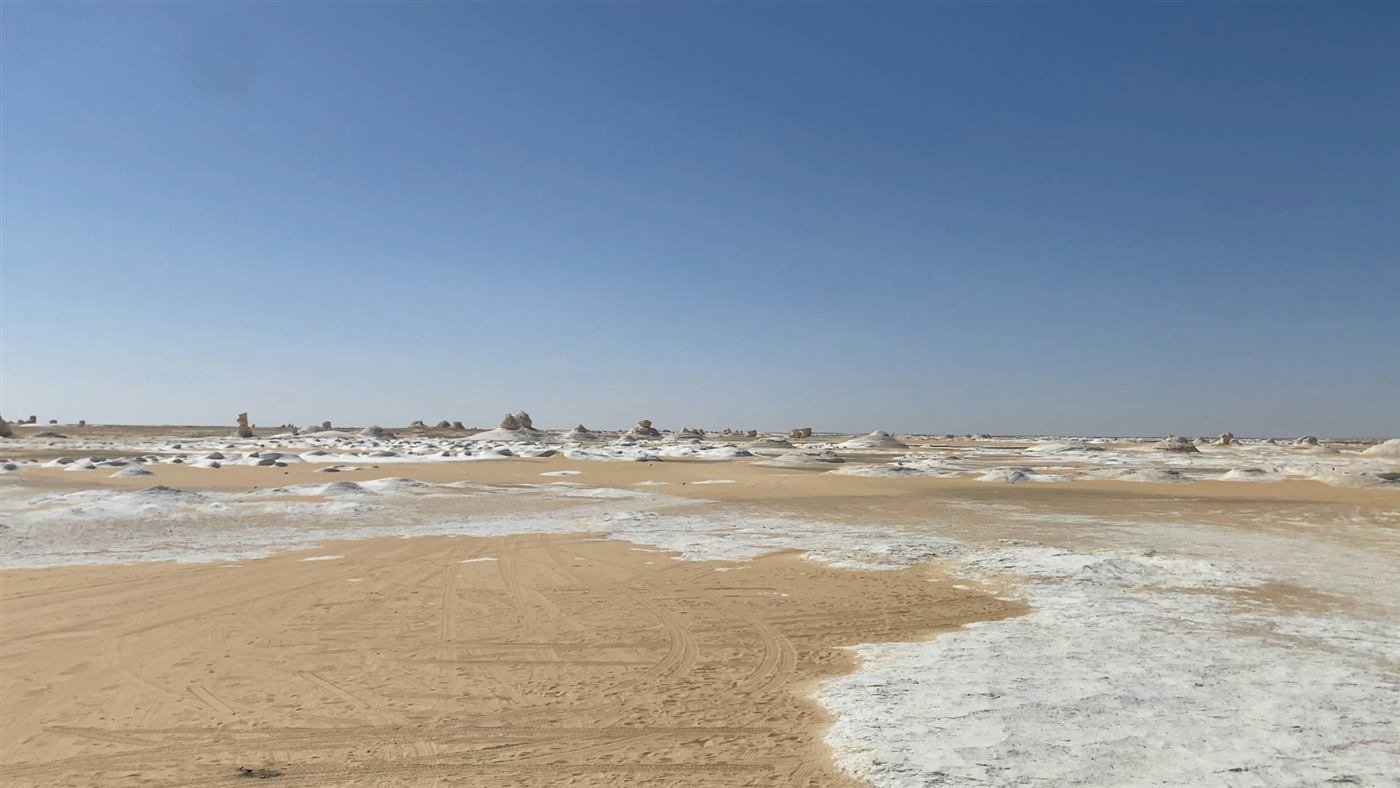
The highlight: a plain of white chalk and limestone carved by wind and sand into thousands of shapes. The two most famous are the “Mushroom” and the “Chicken” (a rock that looks like a chicken beside a tree-like formation), and guides will point out many more. At sunset the rocks turn pink and gold, and under a full moon the whole desert glows white.
Bahariya’s hot springs
Bahariya has several natural springs, some of them warm or hot, used to irrigate the palm groves. Soaking in one after a day in the desert is a classic end to the trip. Swimwear is fine, but dress modestly on the way, as these are rural areas.
A 2-day / 1-night plan
| When | What | Notes |
|---|---|---|
| Day 1, early morning | Leave Cairo by the desert road | About 4–5 hours to Bawiti |
| Day 1, midday | Lunch in Bawiti, switch to a 4×4 | Ask about water and toilets before leaving town |
| Day 1, afternoon | Black Desert, Crystal Mountain, Agabat valley | Short stops for photos and a hill climb |
| Day 1, sunset | White Desert: the Mushroom, the Chicken | The best light of the day |
| Day 1, night | Camp, dinner by the fire, stargazing | It gets cold fast after dark |
| Day 2, sunrise | Walk among the formations | Quiet and soft light |
| Day 2, late morning | Drive back to Bahariya, hot spring | A good place to warm up |
| Day 2, afternoon | Return to Cairo | Arrival in the evening |
Best time to go
The season runs from October to April. Days are pleasant and nights are cool to cold; in December, January and February they can be close to freezing, so take this seriously. Summer is very hot during the day, which makes driving and walking hard work. Spring can bring hot winds and sandstorms (the khamasin), which can hide the views and make camping uncomfortable. For stargazing, nights around the new moon are the darkest; around the full moon the white rocks glow instead. Both are beautiful.
A night under the stars
Most trips camp in the open desert, often sheltered by a rock formation. Camps are usually simple: a windbreak, mattresses, blankets or sleeping bags, and a dinner cooked over the fire. Some people sleep in a tent, others straight under the sky. Ask your operator exactly what is included, especially sleeping bags and toilet arrangements. Small desert foxes (fennecs) sometimes come close to the camp at night looking for food; enjoy them from a distance.
Choosing an operator
- Licensed and experienced: ask whether they are licensed and how long they have been running desert trips.
- Proper 4x4s: in good condition, with a spare tyre and enough water and fuel.
- Permits: operators usually handle permits for the protected area; confirm when booking and carry your passport or ID.
- Clear inclusions: transport from Cairo, meals, water, camping gear, park entry and the hot spring.
Leave no trace
The White Desert is a protected area and its formations are fragile chalk. Don’t climb on thin formations, don’t write on rocks, and take all your rubbish back with you. Don’t take rocks, crystals or fossils as souvenirs: it damages the site, and taking natural material out of protected areas is not allowed.
What to pack
- Warm layers: a fleece, a warm jacket, a hat and socks for the night, even if the day is warm.
- Sun protection: sunglasses, sunscreen and a cap or scarf.
- Closed shoes for walking on sand and rock.
- A headlamp or torch for the camp.
- Swimwear and a small towel for the hot spring.
- Power bank, cash, passport or ID, and any personal medicine.
- Wet wipes and a rubbish bag to take your waste back.
Combine it with Cairo
The desert trip fits neatly into a Cairo itinerary: spend a day or two at the Pyramids and the museums, head out to the desert for two days, then come back for Old Cairo or Khan el-Khalili. Since the road to Bahariya starts on the west side of Cairo, it makes sense to visit the Giza Pyramids just before or after.
Where to stay before and after
Desert trips leave early, so it helps to sleep close to the road. 6th of October and Sheikh Zayed, in west Cairo, sit on the way to the desert road and close to the Giza Pyramids, so you avoid crossing the city at dawn and get back faster when you return tired.
Frequently asked questions
How far is the White Desert from Cairo?
Bahariya Oasis is about 350–370 km from Cairo, roughly 4–5 hours by road, and the White Desert lies further south, towards Farafra. It is a long day of travel, which is why most people stay at least one night.
Is a day trip possible?
Technically, but you would spend most of the day in the car and miss the sunset, the stars and the sunrise. 2 days and 1 night is the minimum we recommend.
Do I need a permit?
The White Desert is a protected area. Operators usually handle permits; confirm when booking and carry your passport or ID.
How cold does it get at night?
Much colder than the day. In winter, nights can be close to freezing. Bring warm layers, a hat and socks, and check whether sleeping bags are included.
Is it suitable for children?
Yes, for many families, especially in autumn or spring when the nights are milder. Pack extra warm clothes and choose an operator with good camping gear.